CO2 laser can soften depressed acne scars, but the right treatment depends on scar shape, skin tone, active acne, tanning status and wound-healing risk. By the end, you will know whether fractional resurfacing fits your problem, when another procedure is a better match and what recovery and safety checks to expect.
Key takeaways
- Fractional CO2 laser suits rolling, boxcar and mixed atrophic acne scars.
- Postpone treatment during active acne, infection, pregnancy or poor wound healing.
- CO2 laser softens scars but rarely removes them completely.
- Check the provider’s medical credentials, laser experience and aftercare plan.
Which acne scars and texture problems respond to CO2 laser?
Fractional CO2 laser is most useful for atrophic acne scars: shallow rolling scars, many boxcar scars and mixed depressions that make the skin surface uneven. It creates microscopic columns of thermal injury while leaving untreated skin between them, prompting wound healing and collagen remodelling. It softens scars; it rarely removes them completely.
| Treatment | How it works | Recovery and best use |
|---|---|---|
| Fractional CO2 laser | Treats columns of skin, preserving surrounding tissue | Several days of redness, swelling, crusting or oozing; commonly used for acne-scar texture |
| Fully ablative CO2 laser | Removes the entire treated surface | Roughly two to three weeks for re-epithelialisation, with redness that can last much longer; reserved for selected extensive resurfacing |
Ice-pick scars often respond poorly to laser resurfacing alone because their narrow defects extend deeply. TCA CROSS or punch excision or elevation may address the depth, with fractional resurfacing used later for remaining unevenness.
CO2 laser targets true depressions and photodamage, not every rough-looking or discoloured area. Ask what is causing the problem before choosing an aggressive treatment:
- Active acne needs control first; resurfacing does not prevent new lesions or scars.
- Brown macules and persistent redness may need pigment- or vascular-focused treatment.
- Enlarged pores, sebaceous filaments and tethered scars may require different procedures.
A fully ablative CO2 laser causes more tissue removal, downtime and complication risk than fractional treatment, so it is not automatically the stronger choice.
Who is a suitable candidate—and who should wait?
Safe candidacy depends on more than the number of scars: a dermatologist must match scar type, skin phototype, medical history and your ability to follow aftercare with the expected benefit.
The strongest candidates are adults with stable, predominantly atrophic acne scars, especially shallow rolling scars and many boxcar scars. Active acne versus acne scars matters: inflammatory or cystic acne should be controlled first because CO2 resurfacing remodels existing scars but does not stop new breakouts or prevent fresh scars.
Fitzpatrick skin types IV–VI are not automatically excluded, but they carry a greater risk of post-inflammatory hyperpigmentation after ablative treatment. A dermatologist may recommend conservative fractional settings, another treatment, or a test area. Recent tanning or sun exposure also calls for postponement until the tan has faded and the skin is stable.
Wait or seek further assessment if you have:
- Active bacterial infection, cold sores or open wounds in the treatment area
- Poorly controlled diabetes, immunosuppression or a condition that delays wound healing
- A strong keloid tendency
- Recent isotretinoin history; disclose the dose and stop date rather than relying on a universal six- or twelve-month rule
- Inability to follow wound care and strict sun protection
Tell the clinician about recurrent facial herpes simplex; antiviral prevention may be needed. Expect improvement, not erased scars. Deep ice-pick scars, severe tethering or mixed scar patterns may need subcision, TCA CROSS, punch surgery or filler instead of—or alongside—CO2.
How does CO2 compare with other scar treatments?
Fractional CO2 is preferable when true depressed scars and rough texture are the main problem, especially shallow boxcar scars, mixed scars and sun-damaged skin. It is not the best answer for every uneven complexion.
| Option | When CO2 is preferable | When the alternative is better |
|---|---|---|
| Microneedling | You need stronger resurfacing for visible depressions and texture. | Choose it for milder scars, lower downtime or a gentler treatment course. |
| Radiofrequency microneedling | Surface texture and photodamage need more correction than controlled heat alone can provide. | Choose it when reducing heat-related pigment risk matters, particularly in darker skin. |
| Subcision | Use CO2 after releasing tethered rolling scars, or when resurfacing addresses the remaining surface irregularity. | Subcision comes first when scar bands pull the skin downward; laser alone cannot release them. |
| Fillers | CO2 is better for widespread shallow texture that filler cannot level economically. | Fillers suit selected deep, broad depressions needing immediate elevation. |
| TCA CROSS | CO2 can refine residual texture after deeper defects are treated. | TCA CROSS or punch treatment suits narrow ice-pick scars, which often respond poorly to resurfacing alone. |
| Chemical peels | CO2 offers more control for substantial textural depressions. | Peels suit superficial pigment or mild roughness with less recovery. |
| Non-ablative lasers and laser toning | CO2 is stronger when texture, not just colour, is the priority. | These options suit redness, brown marks or mild uneven tone. |
Expect a course rather than a guaranteed single session. Scar depth, skin type and combination procedures determine spacing; a one-treatment promise deserves scrutiny.
What happens before, during and after treatment?
Before treatment, your clinician should examine the scars, review recent isotretinoin use, medicines, diabetes, immune problems, poor wound healing and recurrent facial herpes. Active acne, infection, tanning or an inability to follow wound-care and sun-protection instructions can postpone treatment.
Ask whether antiviral prophylaxis is needed, and discuss the higher risk of post-inflammatory hyperpigmentation with Fitzpatrick skin types IV–VI.
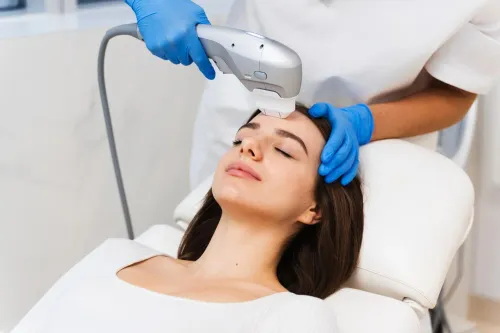
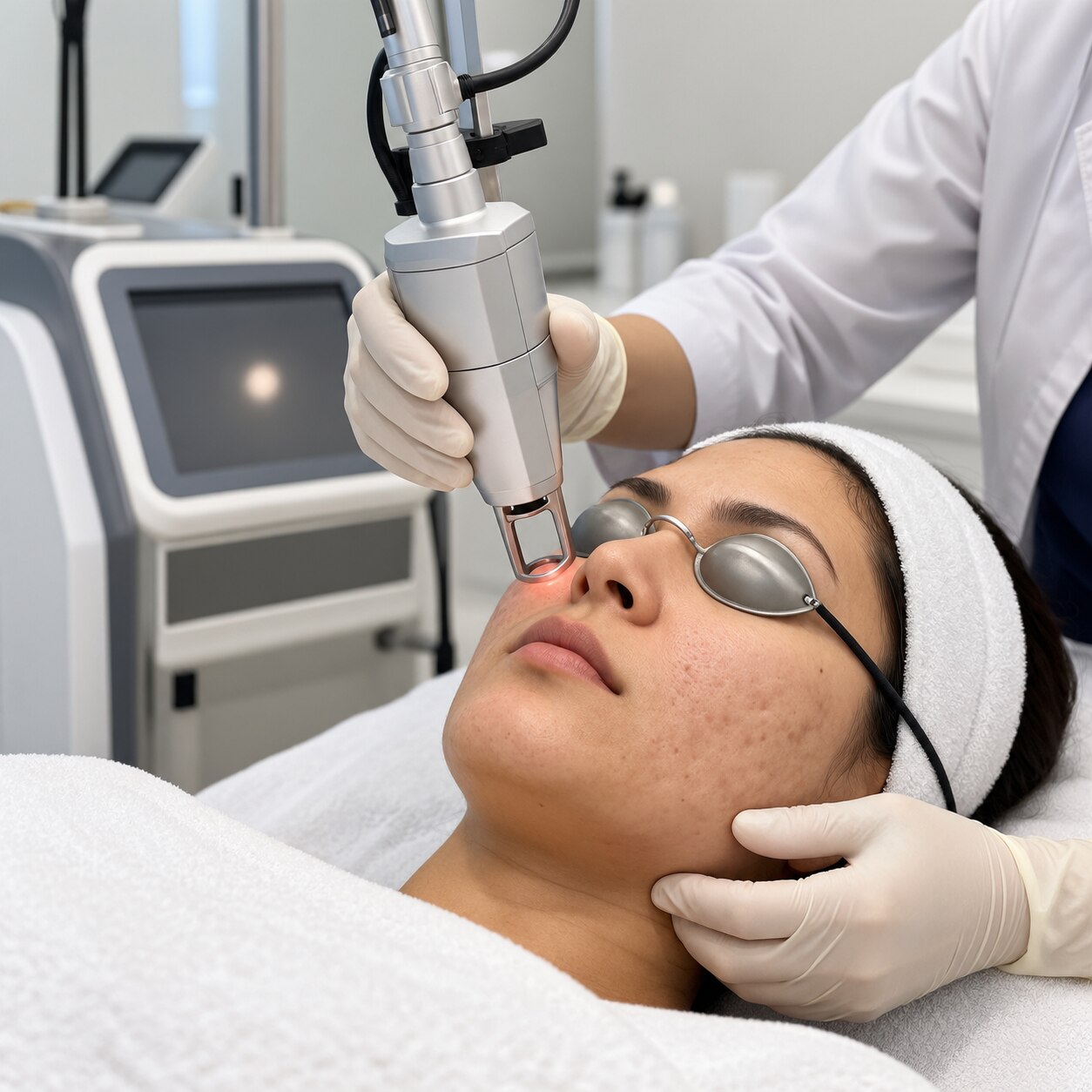
- On treatment day, cleanse the skin and apply topical or injected anaesthesia. You receive eye protection before the laser is used.
- The fractional CO2 handpiece creates microscopic treatment columns, leaving surrounding skin to aid healing. Fully ablative treatment removes a continuous surface layer and requires a longer recovery.
- Immediately afterward, expect heat, redness, swelling and a tight sensation. The clinician applies petrolatum wound care and gives exact washing, ointment and sun-avoidance instructions.
- During the first three to seven days, treated areas can ooze, crust and feel tender. Pink or red skin often persists for one to several weeks; do not pick peeling skin or restart active skincare until cleared.
Skin texture improves gradually as collagen remodels, with meaningful change developing over several weeks and continuing for about three to six months. Acne scars often need multiple sessions spaced according to healing and settings.
Contact the clinic promptly for increasing pain, spreading redness, pus, fever, delayed healing or grouped blisters. Report darkening or pale patches early; post-inflammatory hyperpigmentation and prolonged hypopigmentation need assessment rather than unsupervised bleaching products.
What should you check before choosing a provider?
Choose a dermatologist who offers dermatologist supervision, a specific diagnosis and a plan that allows for more than one session. Ask which findings are true depressed scars and which are redness, pigmentation, active acne, enlarged pores or tethering that need another treatment.
| Check | What a safe answer includes | Warning sign |
|---|---|---|
| Diagnosis | Scar type, skin tone, acne activity and relevant medical history are assessed | Every uneven area is labelled an acne scar |
| Laser plan | The laser mode and settings are explained, including why fractional or fully ablative treatment is chosen | One fixed setting is used for everyone |
| Risk control | Discussion of Fitzpatrick IV–VI pigmentation risk, tanning, herpes history, isotretinoin, diabetes, infection and wound healing | No questions about medicines or previous cold sores |
| Treatment course | Expected number and spacing of sessions, downtime, alternatives and likely limits are written down | A promise of one definitive treatment |
| Aftercare | A test spot and written aftercare plan cover cleansing, ointment, sun avoidance and warning signs | Verbal instructions only |
Ask who performs each stage and whether sterile technique is used for the laser room, dressings and any combined procedure. Grouped blisters, increasing pain or erosions need prompt clinical advice; ask exactly how to report them and whether antiviral prophylaxis applies to you.
At Dr Purva Nucleus Eye And Skin Clinic, use the consultation to compare CO2 resurfacing with peels, microneedling, subcision or fillers when the scar pattern does not justify aggressive laser treatment. A cautious plan is stronger evidence of competence than a dramatic before-and-after photograph.
Related service
Lasers Laser toning is a non-invasive, low-energy laser treatment used to gently rejuvenate the skin and treat pigmentation, melasma, uneven skin tone,... View service → |
Frequently asked questions
Which acne scars respond best to CO2 laser?
Fractional CO2 laser works best for shallow rolling scars, many boxcar scars and mixed atrophic depressions that create uneven texture.
Who should wait before having CO2 laser treatment?
Wait if you have active acne, a skin infection, an open wound, poor wound healing, a recent tan or another condition your clinician needs to assess first.
How does CO2 laser compare with other acne-scar treatments?
CO2 laser improves broad textural depressions through collagen remodelling, while treatments such as subcision, microneedling, chemical reconstruction or fillers suit different scar types.
What should you check before choosing a CO2 laser provider?
Check the clinician’s qualifications, experience with acne scars and fractional CO2 settings, infection-control practices, expected downtime, risks and written aftercare instructions.